.png?width=3799&height=728&name=Dark_Logo_R-01%20(1).png "SignalPET")
Adding more staff or upgrading your software might seem like the obvious way to fix a backed-up schedule, but these solutions often mask the real issue. In many cases, the chaos in your lobby isn't caused by a lack of hands on deck; it's caused by a lack of defined workflow benchmarks. If you've been wondering how to reduce vet clinic bottlenecks without constantly hiring, you're likely looking at the wrong symptoms.
It's exhausting to watch your technicians rush through exams while clients wait past their appointment times. You deserve a calmer environment where the team can actually focus on patient care instead of just surviving the daily rush. We'll help you identify the hidden friction points in your practice and show you how to use data-driven benchmarks to restore a smooth patient flow. This article debunks four common operational myths and provides a clear framework to help your team achieve predictable end times and better utilization of your skilled staff.
Key Takeaways
- Hiring more team members often adds confusion to a broken system. Learn why refining your current workflow is usually the more effective and sustainable first step.
- Identify why lobby congestion is often a symptom of exam room delays. We'll show you how to spot the "exam room stall" before it backs up the front desk.
- Discover how to reduce vet clinic bottlenecks by using consistent clinical protocols to prevent the rushing that actually creates more administrative work later.
- Transition from "gut feelings" to data-driven management by tracking specific KPIs like staff utilization and revenue per appointment.
- Apply clinic benchmarks to restore a calm, predictable patient flow that supports both your team's mental health and the client experience.
The More Staff Myth: Why Hiring Is Not the Only Way to Reduce Vet Clinic Bottlenecks
A bottleneck is simply a point in your workflow where patient demand exceeds the capacity of a specific resource. In a general practice, this resource is often the exam room or the doctor's time. When things get hectic, the natural instinct is to hire more people. However, this is often a hiring trap. Adding more bodies to a disorganized process usually creates more confusion rather than more capacity.
This matters for GP teams because our physical footprints are often fixed. If you have four exam rooms, adding a fifth technician won't magically create more space to see patients. Instead, it often leads to staff members bumping into each other in the pharmacy or treatment area. Understanding the principles of operations management for services helps us see that efficiency comes from flow, not just headcount.
Optimizing Technician Utilization Rates
Leveraging your technicians to their full professional capacity is an effective way to address stalls. When a technician is under-utilized, they spend their time on tasks that don't require their specialized skills. This creates a secondary bottleneck at the veterinarian level. If a DVM is still pulling their own vaccines or scribing every word of a history, the whole clinic slows down. Take a moment to audit your daily tasks. Identify which clinical duties currently performed by doctors could be safely and legally handled by your nursing team. Improving this ratio is a core part of learning how to reduce vet clinic bottlenecks.
Workflow vs. Headcount
A lean, benchmark-driven team will often outperform a clinic with a high headcount but no structure. You have likely seen the "waiting on a doctor" syndrome where three technicians are standing by because the DVM is stuck in a room or finishing notes. This isn't a staffing problem; it's a workflow problem. Before you post a job opening, use the GP practice benchmark tool to see if your current team is being utilized effectively. Focus on role clarity so every team member knows exactly what they should be doing when a stall occurs.
Debunking the Front Desk Fallacy: Identifying Where Delays Actually Start
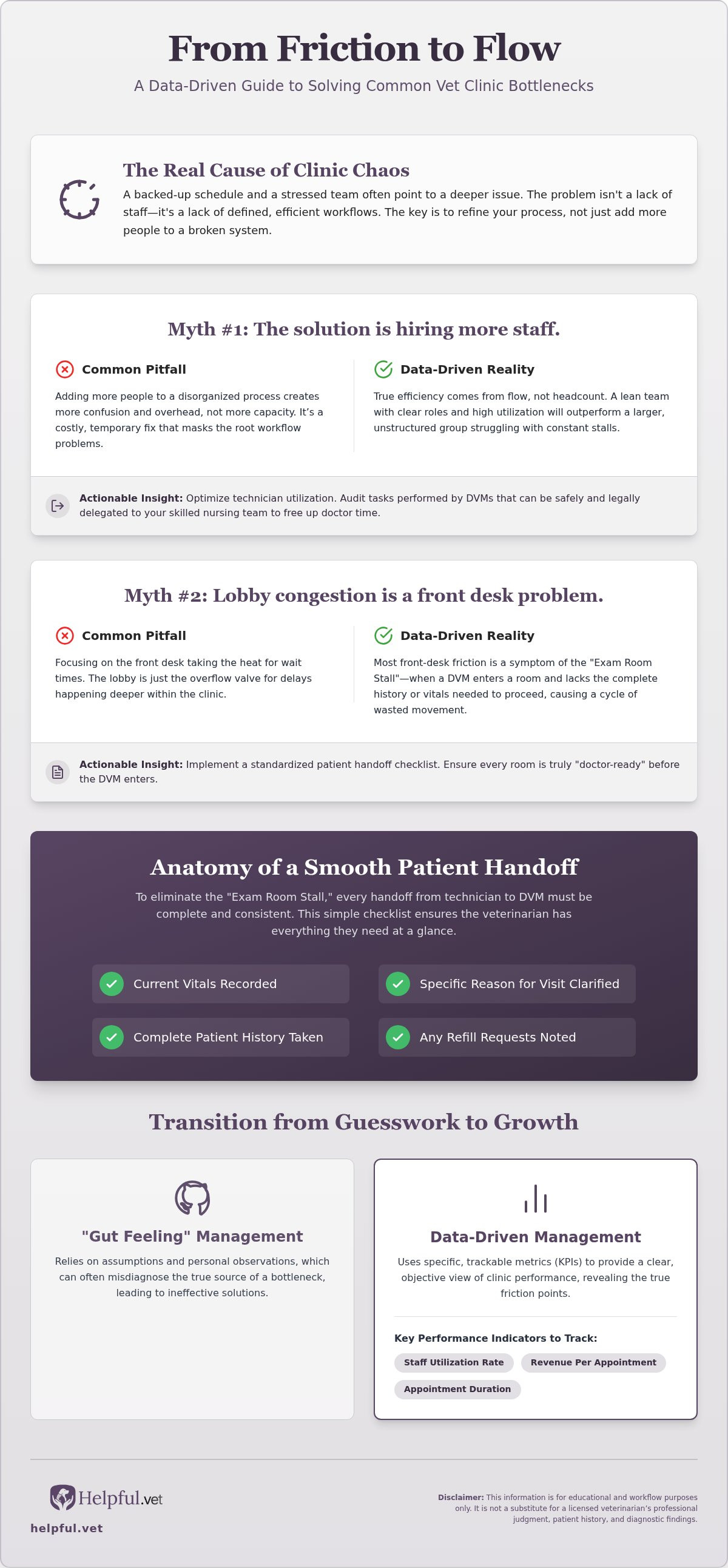
When clients wait too long in the lobby, the front desk usually takes the heat. However, the lobby is just the overflow valve for what's happening in the back. If you want to know how to reduce vet clinic bottlenecks, you have to look past the reception desk and into the exam rooms. Most front-desk friction is actually a symptom of the "exam room stall."
This stall happens when a technician rooms a patient but provides an incomplete history or misses vital signs. When the veterinarian enters and finds they lack the information needed to proceed, they often have to step back out to find the technician or start the history over themselves. This creates a cycle of wasted movement that backs up the entire building. For GP teams, front-desk stress usually stems from this lack of clear communication from the medical team. If reception is left in the dark about a delay, they can't manage the lobby effectively. Using a veterinary clinic workflow checklist can help standardize these handoffs so that every room is truly ready for the doctor.
The Anatomy of a Smooth Patient Handoff
A smooth handoff requires a specific set of data before the DVM enters the room. Implementing Strategies for Better Patient Flow involves "pre-rooming" patients to ensure the veterinarian has everything they need at a glance. This includes current vitals, a specific reason for the visit, and any refill requests. When this information is consistent, it eliminates the need for the doctor to leave the room to ask clarifying questions, which significantly reduces the total appointment duration.
Reducing Treatment Room Friction
Disorganized diagnostic workflows often stall the middle of the day. If a technician has to hunt for a specific blood tube or a clean dental scaler, the patient occupies a treatment table longer than necessary. Standardized intake forms for dental and surgical cases prevent morning chaos by ensuring all owner permissions and pre-op vitals are secured before the first incision. For more practical tips on refining your daily operations, consider joining our community of practice managers and clinic leaders.
The Efficiency Myth: Why Rushing Appointments Often Causes More Backlogs
Moving faster isn't always the same as working better. When a team feels pressured to "catch up," they often cut corners in client education or history taking. This creates a paradox where saving five minutes in the exam room leads to twenty minutes of follow-up phone calls later that day. If a client leaves feeling confused, they will inevitably call back with questions that should have been handled during the visit. This "rework" is a significant hidden drain on your team's time and a major reason why many struggle with how to reduce vet clinic bottlenecks.
Consistent clinical protocols act as a stabilizer for your workflow. When every team member knows the standard of care for a specific presentation, it reduces decision fatigue. This clarity allows for smoother transitions between staff members. Understanding the broader principles of Driving Efficiency and Productivity helps us see that true throughput comes from precision rather than haste. For GP teams, rushing often means missing opportunities for preventive care education, which can impact long-term patient health and clinic revenue.
Strategic Triage and Buffer Times
Protecting your schedule requires tactical pauses. These are brief periods, perhaps fifteen minutes in the mid-morning and mid-afternoon, where no appointments are booked. This allows the team to finish records, return urgent calls, or handle minor delays without the entire day cascading into chaos. Training your front-desk team to distinguish between "urgent" needs that can wait a few hours and true "emergencies" that require immediate intervention is essential for maintaining this flow.
Standardizing Client Communication
Clear communication is a clinical tool, not just a soft skill. You can use the client communication score to measure how effectively your team provides information. When discharge instructions are standardized and written clearly, it prevents the "one more thing" bottleneck at the exit. Clients who feel well-informed are less likely to stall the front desk during checkout. To get more practical resources for your team, sign up for our weekly operational tips. Learning how to reduce vet clinic bottlenecks is often about refining these small, repetitive interactions.
From Friction to Flow: Resolving Operational Stalls
Managing a clinic based on a "gut feeling" often leads to inconsistent results and team frustration. While you might feel like the day is chaotic, data provides a clearer picture of where the actual stalls occur. For GP teams, benchmarks offer a neutral way to discuss performance. Instead of pointing fingers at specific people, you can point to the numbers to identify how to reduce vet clinic bottlenecks together as a team.
Two key metrics are essential for identifying hidden friction points: revenue per appointment and staff utilization rates. If your revenue per appointment is low despite a high patient volume, you might be rushing through visits and missing diagnostic opportunities. Conversely, low staff utilization often indicates that your technicians are waiting for doctor input rather than performing clinical tasks. Using the GP practice benchmark tool allows you to compare your clinic against industry standards to find your specific friction points.
Implementing Data-Driven Workflow Adjustments
Once you've identified a stall, follow a structured framework to resolve it. This prevents the "change for the sake of change" fatigue that often burns out staff. Start with these three steps:
- Step 1: Identify a specific metric that is consistently below industry benchmarks.
- Step 2: Use vet practice operational tools to isolate the specific process causing the delay.
- Step 3: Test a small, controlled change in one area, such as implementing technician-led intake for all wellness visits for one week to see if it speeds up the veterinarian's entry into the room.
Building a Culture of Continuous Improvement
Presenting data to the team requires a supportive approach. Frame the information as a way to reduce everyone's daily stress rather than a critique of individual effort. When the team sees that a small change in rooming protocols results in leaving the clinic on time, they're more likely to buy into future adjustments. It's important to celebrate these small wins. A calmer lobby and a predictable schedule are the ultimate rewards for refining your workflow and learning how to reduce vet clinic bottlenecks.
Restoring Flow to Your Daily Practice
Managing a busy general practice doesn't have to mean constant rushing or lobby chaos. By moving away from the hiring trap and focusing on technician utilization and standardized communication, you can create a more predictable environment for your team and your clients. We've seen that understanding how to reduce vet clinic bottlenecks is ultimately about replacing guesswork with clear, actionable benchmarks. When your team knows the protocols and feels leveraged to their full capacity, the entire clinic operates with more purpose and less stress.
Our goal is to act as your non-judgmental clinical sidekick, providing the resources you need to optimize your workflow without the corporate jargon. We provide data-driven insights for 2026 operations that are currently used by hundreds of GP teams nationwide to restore order to their schedules. If you're ready to move from friction to flow, explore our GP Practice Benchmark Tool to identify your clinic bottlenecks and join our community of practice leaders. You have the talent in your building already; now it's just a matter of giving them the structured path to succeed. You've got this.
Frequently Asked Questions
What are the most common bottlenecks in a veterinary clinic?
The most common bottlenecks usually occur during the handoff between technicians and veterinarians or during the diagnostic phase of an appointment. When a doctor enters an exam room without a complete patient history or vitals, the appointment stalls immediately. Disorganized treatment areas where staff must hunt for supplies also create significant backlogs. Identifying these specific friction points is the first step in learning how to reduce vet clinic bottlenecks and restoring a predictable flow to your day.
How do I know if my vet clinic is understaffed or just inefficient?
You can distinguish between understaffing and inefficiency by looking at staff utilization rates and physical room capacity. If your technicians are frequently idle while veterinarians are overwhelmed, the issue is likely a workflow imbalance rather than a lack of headcount. High staff turnover, which was nearly 50% for technicians nationally in 2026, often suggests that the current team is being used for the wrong tasks. This creates a perceived shortage that is actually a process failure.
Can better client communication really reduce clinic bottlenecks?
Effective client communication directly reduces bottlenecks by preventing the rework of follow-up phone calls and emails. When discharge instructions are clear and provided in writing, clients are less likely to stall the front desk with questions during checkout. This clarity ensures that the lobby stays clear and the medical team isn't interrupted by non-urgent inquiries later. Better communication acts as a clinical stabilizer, allowing the team to focus on the patients currently in the building.
What are the best KPIs to track for veterinary clinic efficiency?
The most impactful KPIs for measuring efficiency include revenue per appointment, technician-to-DVM ratios, and total appointment cycle time. Revenue per appointment helps identify if the team is rushing and missing care opportunities. Staff utilization rates show whether your nursing team is performing at their full professional capacity. Tracking these metrics provides a neutral, data-driven way to discuss operational improvements with your team without the defensiveness that often comes from subjective observations.
How can I improve technician utilization in my practice?
Improving technician utilization starts with a comprehensive audit of daily clinical tasks to see which ones can be safely delegated by the veterinarian. Empowering your nursing team to handle full histories, blood draws, and initial client education allows the doctor to focus strictly on diagnosis and surgery. This shift not only helps you understand how to reduce vet clinic bottlenecks but also increases job satisfaction for your skilled staff. It ensures every team member is working at the top of their license.

Article by
The Helpful.vet Team
The Helpful.vet Team creates practical resources, tools, and checklists for busy general practice veterinary teams. Our content focuses on clinic workflow, client communication, benchmarks, practice efficiency, and everyday tools that help veterinary professionals work with more clarity.
Disclaimer
Helpful.vet provides educational and workflow-related information for veterinary professionals. Content on this site does not provide medical advice, diagnosis, or treatment recommendations and should not replace the judgment of a licensed veterinarian. Clinical decisions should always be made using patient-specific history, examination findings, diagnostics, applicable guidelines, and professional judgment.