.png?width=3799&height=728&name=Dark_Logo_R-01%20(1).png "SignalPET")
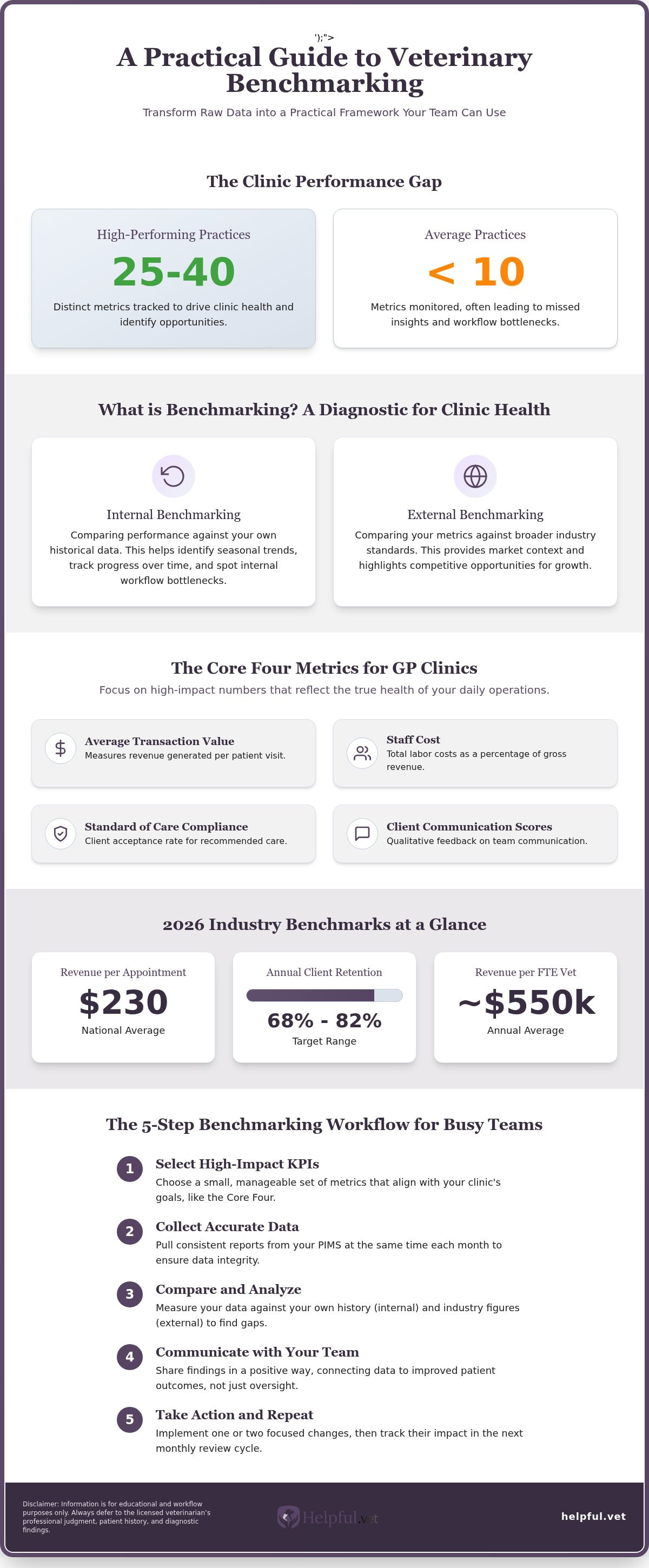
High-performing veterinary practices typically track between 25 and 40 distinct metrics, while the average clinic often monitors fewer than ten. This gap isn't about having more software; it's about knowing which numbers actually drive clinic health. It's common to feel overwhelmed by the dense reports your PIMS generates every month. You want to improve your workflow, but staring at spreadsheets often feels more like a chore than a path to better patient care. Comparing your unique GP team to national averages can also feel frustrating when those numbers don't seem to reflect your daily reality. This guide will show you how to benchmark a veterinary practice by transforming raw data into a practical framework your whole team can actually use.
We'll break down the essential KPIs to track, establish a repeatable monthly review workflow, and provide the tools you need to boost clinic efficiency and revenue without adding hours to your administrative schedule. By focusing on actionable insights rather than information overload, you can empower your team to make data-driven decisions that improve both the bottom line and the quality of care.
Key Takeaways
- Identify workflow bottlenecks by comparing your clinic performance against industry standards and your own historical data.
- Focus on a small set of high-impact KPIs, such as revenue per appointment, to track how effectively your team captures charges for services.
- Discover how to benchmark a veterinary practice using a repeatable 5-step workflow that fits into a busy monthly schedule.
- Empower your team by connecting operational data to improved patient outcomes rather than using benchmarks as a tool for oversight.
Defining Benchmarking for the Modern General Practice
Benchmarking is more than just a business term; it is a clinical diagnostic for your clinic's health. At its core, Defining Benchmarking involves comparing your performance metrics against either your own historical data or broader industry standards. Understanding how to benchmark a veterinary practice allows you to move past gut feelings and make decisions based on objective numbers. The numbers provide clarity.
Internal benchmarking focuses on your clinic's specific journey. By tracking your progress month over month, you can identify seasonal trends or hidden workflow bottlenecks that slow down your technicians. For example, you might notice that revenue patterns shift when you introduce new diagnostic protocols. External benchmarking provides the context you need to see where you stand in the market. It highlights competitive opportunities you might miss if you only look inward.
Internal vs. External Data Points
Specific internal data points are essential for setting realistic goals tailored to your team size and equipment. This prevents unfair comparisons between a small rural clinic and a large urban hospital. External data provides context from authoritative veterinary research bodies and industry surveys. For current industry stats and 2026 averages, review the 2026 Veterinary Clinic Benchmarks: GP Operational Guide. These external figures act as a compass for your practice's growth.
Learning how to benchmark a veterinary practice provides an objective baseline for making equipment or staffing decisions. If your appointment volume is high but your team is exhausted, the data might signal that it's time to hire another technician or upgrade your diagnostic suite to improve efficiency. This shift from gut feeling to data-driven management reduces stress and improves team morale.
Selecting High-Impact KPIs: What Actually Moves the Needle?
Tracking dozens of metrics is a recipe for team burnout. Instead, treat your Key Performance Indicators (KPIs) like clinical vital signs. When learning how to benchmark a veterinary practice, focus on a few high-impact numbers that reflect the actual health of your daily operations. Revenue per appointment is a top indicator of charge capture. It tells you if your team is consistently billing for the value they provide or if services are slipping through the cracks.
Technician utilization is a benchmark many practices overlook. This metric reveals if your nursing team is practicing at the top of their license or spending too much time on non-clinical tasks. High utilization correlates with better revenue per full-time equivalent veterinarian, which in 2026 averages around $550,000 for many small animal practices. Empowering your technicians to lead dental cleanings or diagnostic screenings directly impacts this number.
Client retention rates reflect the health of your long-term relationships. The 2026 industry benchmark for annual client retention is between 68% and 82%. If your retention drops below this range, your marketing costs will likely increase as you struggle to replace lost clients. Stable retention is the foundation of a predictable GP workflow.
The Core Four Metrics for GP Clinics
To keep your data review manageable, focus on these four areas:
- Average Transaction Value (ATV): The revenue generated per patient visit.
- Staff Cost: Total labor costs measured as a percentage of gross revenue.
- Standard of Care Compliance: How often clients accept recommended diagnostics or treatments.
- Client Communication Scores: Qualitative feedback on how well your team explains medical plans.
You can use the Helpful.vet GP practice benchmark tool to track these core metrics without building complex spreadsheets from scratch.
Why Revenue per Appointment Matters
This metric identifies if your team is missing opportunities for essential diagnostics or preventative care. It's not about upselling; it's about ensuring patients get the care they need. If your average charge is significantly lower than the 2026 national average of $230, there might be a gap in your clinical workflow. Review the Maximizing Vet Clinic Revenue per Appointment guide for a deeper analysis of these gaps. To stay updated on operational tips, subscribe to our newsletter for regular insights.
The 5-Step Benchmarking Workflow for Busy Teams
Understanding how to benchmark a veterinary practice is only half the battle. The real challenge is integrating it into a schedule already packed with appointments and surgeries. To avoid burnout, you need a methodical approach that prioritizes consistency over complexity. This 5-step framework turns data review into a predictable clinic habit.
Step 1: Define your goals. Avoid the temptation to track everything. Choose two or three specific areas for improvement, such as dental revenue or technician utilization. Step 2: Collect data. Pull reports from your practice management software (PIMS) and accounting tools on a consistent monthly schedule. Step 3: Clean the data. Ensure you are comparing like for like by excluding non-clinical revenue, such as boarding or retail, which can skew medical performance figures.
Step 4: Analyze the results. Learning how to benchmark a veterinary practice effectively means using interactive resources like the Helpful.vet tools page to process your numbers. These calculators remove the manual math from the process. Step 5: Share findings. Transparency fosters a culture of growth. When the team sees how their efforts impact clinical outcomes, they are more likely to support operational changes.
Data Collection Without the Headache
Efficiency starts with delegation. Assign specific data points to different team members to distribute the workload. For instance, a lead technician can track diagnostic compliance while the office manager pulls revenue reports. Use automated PIMS reports whenever possible to save time. Finally, schedule a standing 30-minute "Data Huddle" once a month. This dedicated time ensures that benchmarking doesn't fall off the radar when the clinic gets busy. To get more practical workflows delivered to your inbox, sign up for our newsletter.
Turning Data into Action: Communicating Benchmarks to Your Team
Benchmarking often fails when it's presented as a management oversight tool rather than a collaborative resource. When you learn how to benchmark a veterinary practice, the goal should be team empowerment. Avoid using data as a stick to punish performance. Instead, use it to identify where clinic systems might be breaking down. If revenue per appointment is low, it's rarely because a veterinarian is too slow; it's usually because the workflow doesn't support thorough charge capture. Celebrate small wins, such as a 5% improvement in diagnostic compliance, to keep morale high and build momentum.
Always connect the numbers directly to patient outcomes. High efficiency ensures that more pets receive the preventive care they need without the team feeling rushed or overwhelmed. Use the Standard of Care Self-Check to align your operational benchmarking with clinical excellence. This keeps the conversation grounded in your primary mission: providing the best possible medicine. When the team sees that data leads to better care, they're more likely to buy into the process and contribute their own ideas for improvement.
The "Why This Matters" Angle for Staff
Clear benchmarks provide a practical benefit that resonates with the entire staff. Better technician utilization leads to more predictable workdays and significantly less unplanned overtime. This reduces the daily grind and helps prevent burnout across the nursing team. Additionally, increased revenue allows for facility upgrades and newer equipment, like digital dental radiography or advanced ultrasound units. Encourage your technicians to lead the way by tracking their own efficiency metrics. When nurses have agency over their workflows, they can focus on what they do best while helping the clinic thrive.
Empowering Your Practice Through Data
Benchmarking is a clinical workflow habit that helps you move beyond gut feelings to make informed decisions for your clinic. By focusing on a few vital signs like revenue per appointment and technician utilization, you can identify exactly where your systems need support. This framework provides a steady hand for practice management, ensuring that your GP team remains efficient and focused on patient care. It's about progress, not perfection.
Please remember that all clinical data and metrics provided are for educational and workflow purposes only. You should consult with your practice owner or CPA before implementing major financial or operational changes. To stay ahead of industry trends and receive practical resources, join our newsletter for monthly benchmarking tips and free clinic tools. Learning how to benchmark a veterinary practice is the first step toward a more predictable and rewarding workday for your entire team. You've got the data; now you have the plan to use it.
Frequently Asked Questions
How often should a veterinary practice perform benchmarking?
You should review your core benchmarks on a monthly basis to stay ahead of seasonal trends. While annual reviews are helpful for long-term planning, a monthly cadence allows you to identify workflow bottlenecks as they happen. This consistent schedule ensures that data collection becomes a habit for your team rather than a stressful quarterly project. It's the best way to maintain a steady hand in clinic management.
What are the most important KPIs for a general practice to track?
Focus on a small set of vital signs like revenue per appointment, which averages around $230 in 2026. You should also monitor technician utilization and annual client retention, which typically ranges between 68% and 82%. Tracking staff costs as a percentage of gross revenue is another essential metric. These four KPIs provide a high-level view of your clinic's operational health without causing information overload.
Can a small clinic use the same benchmarks as a large hospital?
Yes, you can use the same types of metrics, but you must interpret them through the lens of your specific team size. For example, revenue per appointment is a universal indicator, but your total gross revenue will naturally differ from a multi-doctor hospital. When learning how to benchmark a veterinary practice, focus on percentages and averages rather than raw totals to ensure you are making fair comparisons.
Do I need special software to start benchmarking my practice?
You don't need expensive new software to begin. Most practice management systems already generate the raw reports you need for monthly reviews. The key is knowing how to benchmark a veterinary practice by extracting that data into a simple spreadsheet or using free interactive calculators. Investing in a new platform is often less effective than establishing a repeatable process for reviewing the data you already have.
How do I get my veterinary team to care about benchmarking data?
The best way to build buy-in is to connect the numbers to patient care and team well-being. Explain how better technician utilization leads to less overtime and a more predictable schedule. When you show the team that improved revenue per appointment allows for new equipment or facility upgrades, the data feels like a tool for empowerment. Celebrate small wins together to keep the focus on growth and clinical excellence.

Article by
The Helpful.vet Team
The Helpful.vet Team creates practical resources, tools, and checklists for busy general practice veterinary teams. Our content focuses on clinic workflow, client communication, benchmarks, practice efficiency, and everyday tools that help veterinary professionals work with more clarity.
Disclaimer
Helpful.vet provides educational and workflow-related information for veterinary professionals. Content on this site does not provide medical advice, diagnosis, or treatment recommendations and should not replace the judgment of a licensed veterinarian. Clinical decisions should always be made using patient-specific history, examination findings, diagnostics, applicable guidelines, and professional judgment.