.png?width=3799&height=728&name=Dark_Logo_R-01%20(1).png "SignalPET")
It’s 6:30 PM on a Tuesday; the last patient left thirty minutes ago, but your team is still hunched over keyboards finishing records while their dinner grows cold at home. If this sounds like a typical shift, you aren't alone. Many general practice teams feel that a chaotic schedule is simply an unavoidable cost of doing business. However, struggling with veterinary clinic time management isn't a clinical necessity; it's often a symptom of a workflow that hasn't adapted to the modern pace of medicine. With veterinarian salaries averaging $165,527 in 2026, every minute of lost productivity impacts the clinic's ability to support its staff and provide high-quality care.
We understand that the "squeeze one more in" culture leads to burnout and the chart lag that keeps you late. This guide offers a practical template to help you master your daily schedule through better technician utilization and structured transitions. You'll learn how to implement a framework that ensures smoother patient flow and allows your team to leave on time. We will walk through the specific steps to reorganize your appointment blocks and improve communication so the clinic runs with calm reliability instead of constant rushing.
Key Takeaways
- Implement a four-part daily flow framework to stabilize veterinary clinic time management and ensure your team leaves on time.
- Optimize technician utilization by delegating non-veterinary tasks, which removes common bottlenecks in the daily appointment schedule.
- Move beyond subjective feelings of busyness by using clinic benchmarks to identify specific gaps in your operational flow.
- Use structured transitions between peak periods to maintain consistent standards of care and reduce staff fatigue throughout the shift.
Veterinary Clinic Time Management: Why GP Teams Struggle
Effective veterinary clinic time management is the strategic allocation of team resources to balance clinical patient care with smooth operational flow. In the demanding field of veterinary medicine, this isn't just a soft skill; it's a vital framework for reducing staff fatigue and maintaining consistent standards of care. Why does this matter for GP teams? Because the variety of cases is so broad, transitions between appointments are often where time is lost. When a clinic lacks structure, teams often fall victim to the "unpredictability myth." This is the belief that because emergencies happen, a structured schedule is impossible. In reality, most delays are systemic. Proper management directly impacts clinic revenue per appointment by ensuring the team spends more time on billable clinical tasks rather than administrative recovery.
Clinics that ignore their schedule often see a decline in both team morale and profitability. You can use the GP Practice Benchmark Tool to see how your current flow compares to industry standards. Identifying these gaps is the first step toward reclaiming your day and ensuring your staff doesn't feel perpetually behind. When every minute is accounted for, the entire team can focus on the patient in front of them instead of worrying about the three waiting in the lobby.
The Cost of Appointment Overrun
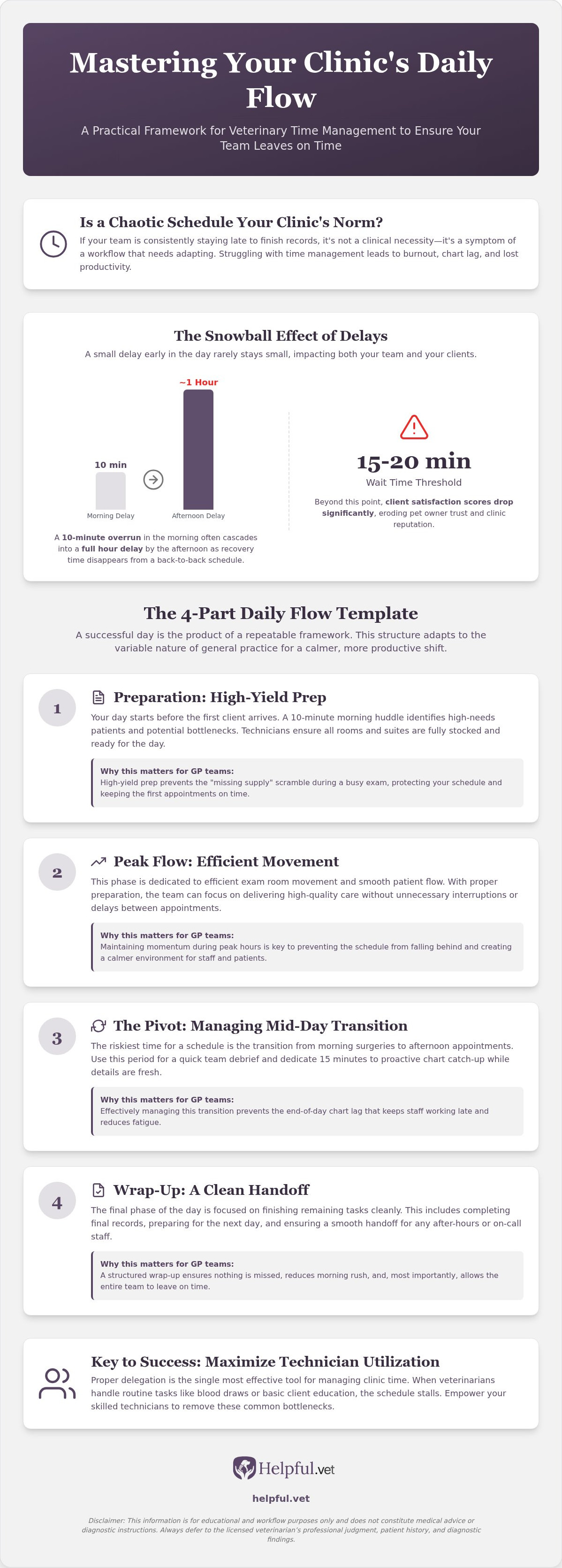
A slight delay early in the shift rarely stays small. A ten minute overrun in the morning often cascades into a full hour delay by the afternoon. This happens because recovery time is nonexistent in a back-to-back schedule. Every late start consumes the buffer meant for records or pharmacy calls. Beyond team stress, this erosion of time damages client trust. Pet owners generally have a low wait time threshold. Once delays exceed 15 to 20 minutes, client satisfaction scores drop significantly. For specific strategies on fixing these bottlenecks, see our guide on How to Reduce Appointment Overrun.
Disclaimer: This information is for educational and workflow purposes only and does not constitute medical advice or diagnostic instructions.
The Daily Flow Template: Structuring a Productive Clinic Schedule
A successful day isn't a result of luck; it's the product of a repeatable framework. To master veterinary clinic time management, we recommend a four-part daily flow: Preparation, Peak Flow, The Pivot, and Wrap-Up. This flexible framework adapts to the variable nature of general practice. While Peak Flow focuses on efficient exam room movement and Wrap-Up ensures a clean handoff, the transitions often require the most focus. Using specific veterinary clinic workflow strategies can help your team identify where these phases currently break down.
Morning Huddles and High-Yield Prep
Your day starts before the first client walks through the door. A 10 minute morning huddle is the most effective way to identify high-needs patients, surgical risks, or potential staffing bottlenecks. During this time, technicians should ensure exam rooms and surgical suites are fully stocked and ready. Why this matters for GP teams: High-yield prep prevents the "missing supply" scramble during a busy exam, keeping your first three appointments on schedule and protecting the rest of your day.
Managing the Mid-Day Transition
The most dangerous time for a clinic schedule is "The Pivot." This is the period when morning surgeries conclude and afternoon appointments begin. Use this transition for a quick team debrief and proactive chart catch-up. Instead of letting records pile up, dedicate 15 minutes to finishing morning notes while the details are fresh. Why this matters for GP teams: Managing this transition effectively prevents the end of day lag that keeps staff late. If you find these tips helpful, stay updated with our latest workflow resources for more clinical insights.
Disclaimer: This information is for educational and workflow purposes only and does not constitute medical advice or diagnostic instructions.
Maximizing Efficiency Through Technician Utilization
Proper delegation is the single most effective tool for veterinary clinic time management. When a veterinarian handles routine tasks like blood draws or basic client education, the appointment schedule inevitably stalls. These are common bottlenecks that skilled technicians can safely and efficiently manage. In 2026, state regulations are increasingly expanding the roles of veterinary technicians to address industry shortages. Adopting a team-based care model means everyone works at the top of their license. This "Smart Clinical Sidekick" approach ensures the veterinarian focuses on diagnosis, surgery, and treatment plans while the rest of the team keeps the workflow moving. For a practical list of delegation ideas, review our Vet Clinic Exam Room Efficiency checklist.
Why this matters for GP teams: Effective utilization isn't just about speed; it's about clinic capacity. Freeing a veterinarian from routine technical tasks can save hours per shift, which translates to better patient care and a higher standard of service. It also prevents the "waiting room pile-up" that occurs when a vet is stuck performing tasks that a technician could handle with equal skill.
Streamlining Client Communication
Technicians are often the most influential point of contact for pet owners. By leading history taking and providing discharge instructions, they ensure the veterinarian enters the exam room with essential context already established. This removes the need for repetitive questioning and keeps the appointment moving. You can use the interactive tools at Helpful.vet to measure your team’s communication efficiency. Tracking these metrics reveals whether administrative hurdles are slowing down your veterinary clinic time management. To stay informed on the latest delegation strategies and clinic benchmarks, sign up for our newsletter today.
Disclaimer: This information is for educational and workflow purposes only and does not constitute medical advice or diagnostic instructions.
Using Data to Refine Your Clinic Time Management
Many teams describe their days as chaotic or non-stop, but subjective feelings are difficult to manage. To truly improve veterinary clinic time management, you must move from feeling busy to knowing your numbers. Tracking metrics like average appointment duration and staff idle time reveals exactly where the flow stops. For example, if your tracking shows that the transition between morning surgeries and afternoon appointments consistently takes longer than scheduled, you can address that specific gap rather than guessing at the cause.
Data-driven management allows for surgical precision in your workflow. Instead of a massive overhaul, look for the "hidden" minutes lost in room turnovers or late-start procedures. If your tracking shows that technician utilization is low during mid-morning, you might reallocate pharmacy refills or lab work to that specific window. Why this matters for GP teams: Small, data-backed changes are more sustainable than total schedule redesigns. They provide proof of progress, which boosts team morale and reduces the friction of change.
Benchmarking Your Team Performance
Establishing a baseline is the essential first step toward meaningful improvement. You can use the GP Practice Benchmark Tool to compare your clinic's current performance against verified industry standards. These findings provide the objective clarity needed to adjust your daily flow template for the specific challenges of 2026. Knowing exactly where your bottlenecks exist ensures that your veterinary clinic time management efforts are both targeted and effective. Your final next step is to establish this baseline today, giving your team the data they need to build a smoother, more predictable workday.
Disclaimer: This information is for educational and workflow purposes only and does not constitute medical advice or diagnostic instructions.
Reclaim Your Clinic Day
Mastering veterinary clinic time management isn't about working harder; it's about working smarter through structured transitions and proper delegation. By implementing the four-part daily flow template and empowering your technicians to work at the top of their license, you can eliminate the end of day chart lag and improve team morale. Remember that small, data-driven adjustments based on clinic benchmarks are more effective than attempting a total schedule overhaul overnight. These practical resources are designed specifically for the unique pace of general practice in 2026.
Join our newsletter for more practical GP workflow tools and templates, including interactive clinic benchmark tools developed for busy GP teams. Taking the first step toward a more predictable schedule is the best way to support your staff and your patients. You have the means to build a calmer, more efficient clinic starting with your next shift.
Disclaimer: This information is for educational and workflow purposes only and does not constitute medical advice or diagnostic instructions.
Frequently Asked Questions
How can a small clinic implement time management with limited staff?
Small clinics can implement better flow by identifying the most significant bottleneck, which is usually the veterinarian performing technician-level tasks. Effective veterinary clinic time management relies on clear role definition to prevent overlapping efforts. Focus on "one-touch" workflows where the person who starts a task finishes it. This reduces time lost in handoffs and ensures that limited staff aren't constantly switching contexts.
What is the best way to handle 'work-ins' and emergencies without ruining the schedule?
The best way to handle work-ins is to build "buffer blocks" into your daily flow template specifically for urgent cases. Rather than squeezing emergencies into existing appointments, use pre-designated 15 or 20 minute slots in the late morning and mid-afternoon. If no emergency arrives, use this time for catching up on records. This approach protects your scheduled clients while allowing the team to provide immediate care.
How do we get the whole team on board with a new time management template?
Getting the whole team on board requires focusing on the "why" by highlighting how the changes will reduce late finishes and staff burnout. Involve the team in the transition phase by asking for their input on current bottlenecks. When staff see that a new template isn't about working faster but about working with less friction, they're more likely to adopt it. Sharing benchmark data provides objective proof.
Can better time management actually improve the quality of patient care?
Yes, better veterinary clinic time management directly improves the quality of patient care by reducing the rushing that leads to clinical errors. When a team isn't perpetually behind, they can spend more focused time on patient exams and thorough client education. A calm environment also benefits the patients, as pets often mirror the stress levels of the medical team. Better flow ensures consistent standards of care.
What are the most common time-wasters in a general practice veterinary clinic?
Common time-wasters include searching for missing supplies, repetitive history taking, and delayed record keeping. Inefficient communication between the front desk and the clinical floor also creates significant lag. By centralizing supplies and using standardized technician-led histories, you can reclaim hours of lost productivity. Addressing these small drains on time is often more impactful than trying to speed up the actual medical procedures.
Disclaimer: This information is for educational and workflow purposes only and does not constitute medical advice or diagnostic instructions.

Article by
The Helpful.vet Team
The Helpful.vet Team creates practical resources, tools, and checklists for busy general practice veterinary teams. Our content focuses on clinic workflow, client communication, benchmarks, practice efficiency, and everyday tools that help veterinary professionals work with more clarity.
Disclaimer
Helpful.vet provides educational and workflow-related information for veterinary professionals. Content on this site does not provide medical advice, diagnosis, or treatment recommendations and should not replace the judgment of a licensed veterinarian. Clinical decisions should always be made using patient-specific history, examination findings, diagnostics, applicable guidelines, and professional judgment.