.png?width=3799&height=728&name=Dark_Logo_R-01%20(1).png "SignalPET")
Why are your most talented team members spending their shifts on basic tasks while your veterinarians are drowning in paperwork? In 2026, a comprehensive veterinary technician skills checklist is no longer just a training document; it's a critical operational asset for any general practice. You've likely felt the frustration of inconsistent standards of care across different shifts or watched skilled technicians leave because they felt underutilized and bored. These are not just staffing issues; they are workflow bottlenecks that impact your bottom line and patient outcomes.
We know that a steady, reliable clinic environment depends on clear expectations and professional growth. This guide offers a practical, data-driven approach to help you empower your technician team and optimize your daily operations. You'll learn how to move beyond static checklists to create a dynamic system that aligns with new legislative shifts, such as expanded scopes of practice and mandatory licensure. We'll show you how to build an efficient exam room flow that increases job satisfaction and provides the data-backed evidence of team growth you need to lead a modern veterinary practice with confidence.
Key Takeaways
- Transform your technical team from assistants into high-level clinical partners by treating skill development as a dynamic growth roadmap rather than a static performance review.
- Identify the essential 2026 competencies for general practice, including advanced anesthesia monitoring, dental prophylaxis, and proficient in-house diagnostic counseling.
- Learn how to use a veterinary technician skills checklist to conduct a clinical audit and identify "Skill Champions" who can mentor the rest of your team.
- Connect technician utilization to specific clinic benchmarks, such as revenue per appointment and client throughput, to drive operational efficiency.
- Simplify the annual review process by using structured data to track individual growth and technical proficiency throughout the year.
Why a Veterinary Technician Skills Checklist is Essential for GP Efficiency
In many general practices, the veterinary technician skills checklist is often relegated to a dusty binder used only during annual performance reviews. This approach misses the primary value of the tool. A well-structured checklist functions as a dynamic growth roadmap that transforms your support staff from task-oriented assistants into high-level clinical partners. By clearly defining what a team member can and cannot do, you create a predictable environment where veterinarians can delegate with confidence. It's about moving from a culture of "asking for help" to a culture of "expected technical mastery."
This clarity directly reduces the cognitive load on veterinarians during high-volume shifts. When a doctor doesn't have to guess if a technician is proficient in catheter placement or anesthesia induction, they can focus entirely on diagnostic reasoning and client communication. With new 2026 mandates like Minnesota requiring official licensure for technicians, the professional standard for the Paraveterinary worker has never been higher. Leveraging this expertise is the fastest way to improve room turnover and maintain a high standard of care without increasing doctor fatigue.
The Connection Between Skill Tracking and Utilization Benchmarks
Effective utilization starts with data. If your clinic experiences bottlenecks in the dental suite or during afternoon diagnostic workups, the cause is often a skill gap rather than a staffing shortage. Tracking these competencies allows management to identify exactly where training is needed. You can use clinic benchmark tools to measure how your team's current performance compares to industry standards. This identifies hidden inefficiencies, such as having only one team member capable of performing dental radiographs, which can stall an entire morning of procedures.
Reducing Burnout Through Professional Growth
Staff turnover in general practice often stems from a lack of professional agency. Technicians who feel underutilized quickly become disengaged and look for opportunities elsewhere. Using a checklist to create clear career advancement paths gives your team a sense of purpose. It turns a daily job into a series of professional achievements. When a technician sees a clear path from basic triage to advanced diagnostic imaging, they're more likely to stay and grow with your practice. Empowered technicians don't just work faster; they're more invested in the clinical success of every patient.
Core Competencies: Structuring Your Skills Checklist for 2026
A modern veterinary technician skills checklist should reflect the shift toward an expanded scope of practice. In 2026, a well-rounded technician manages the entire patient visit from intake to discharge. This reduces the friction of constant hand-offs and keeps the doctor focused on complex diagnosis and treatment planning. When every team member understands their specific clinical and operational boundaries, the entire practice moves with more purpose.
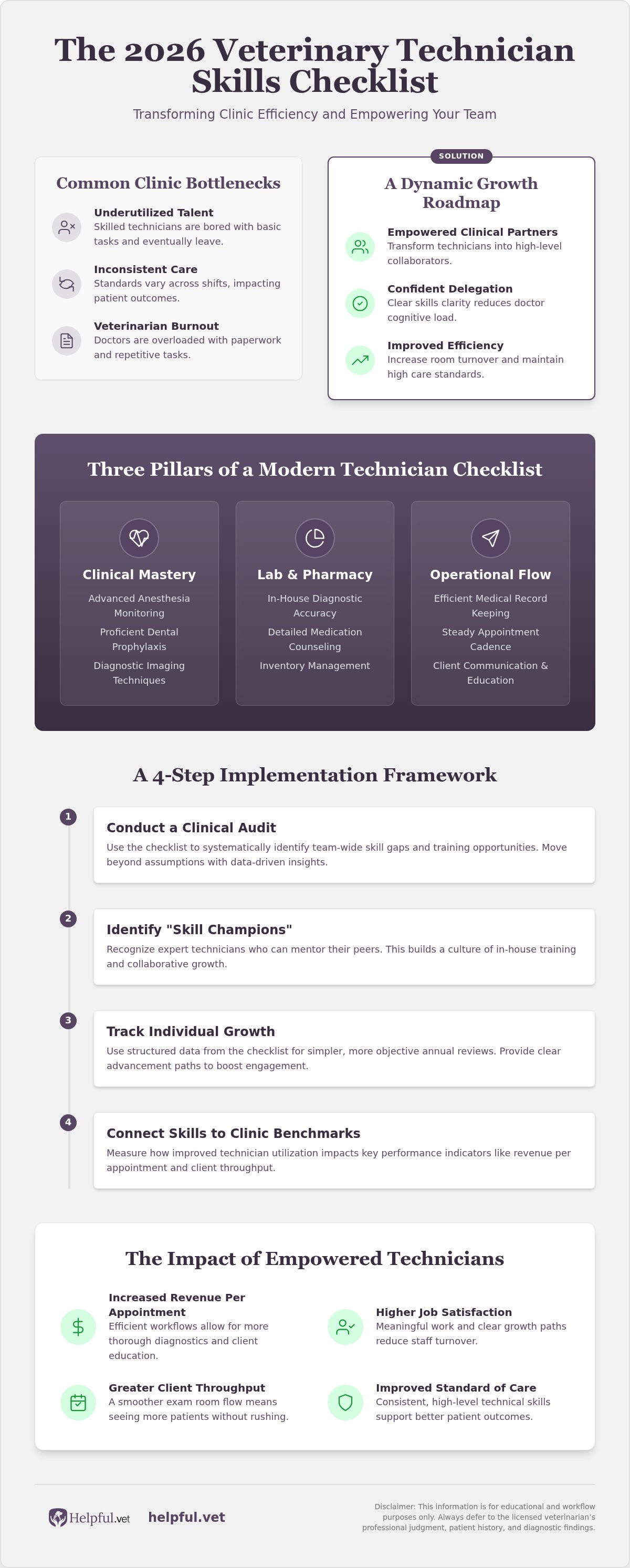
Your checklist should be categorized into three main pillars to ensure comprehensive coverage of the GP workflow:
- Clinical Mastery: Proficiency in anesthesia monitoring, dental prophylaxis, and advanced diagnostic imaging techniques.
- Laboratory and Pharmacy: Accuracy in performing in-house diagnostics and providing detailed medication counseling to pet owners; to further enhance your team's knowledge, visit PharmEDU for a comprehensive pharmacology review.
- Operational Flow: Efficient management of medical record documentation and the ability to maintain a steady appointment cadence.
The Importance of Communication and Soft Skills
Technicians often act as the primary educators for clients. When a technician leads a session on post-operative care or nutritional management, they free up the veterinarian to handle the next consultation. This requires specific training in empathetic listening and clear, jargon-free explanation. You can use the Client Communication Score tool to audit these soft skills and identify where your team might need more support. Improving these interactions directly impacts client compliance and clinic revenue.
Advanced Diagnostics and Modern Technology
As digital workflow platforms and automated diagnostic tools become standard, technicians must be proficient with these new systems. This includes managing telehealth portals and navigating AI-assisted imaging software. While this information is for educational purposes and technicians must always defer to the licensed veterinarian for final medical decisions, their ability to master modern tech is vital. For more updates on evolving industry standards and practical tips, consider signing up for our veterinary workflow newsletter.
Implementing the Checklist: A Step-by-Step Workflow Framework
Simply possessing a veterinary technician skills checklist won't change your clinic's culture. You must integrate it into the daily rhythm of the practice to see real results. Implementation shouldn't feel like an additional burden; instead, it should be the framework that makes the existing workload more manageable. By following a structured approach, you can move from a disorganized "all hands on deck" mentality to a precise, skill-based delegation model.
- Step 1: Conduct an initial audit. Evaluate where each team member currently stands compared to 2026 industry benchmarks. This baseline allows you to see exactly where your clinic's technical bottlenecks are located.
- Step 2: Identify "Skill Champions." Select technicians who excel in specific areas, such as dentistry or laboratory diagnostics, to act as mentors. This decentralizes training and empowers your top performers.
- Step 3: Integrate micro-learning. Use your daily huddles to practice one specific skill at a time. Five minutes of focused review on anesthesia machine troubleshooting is more effective than a four-hour seminar once a year.
- Step 4: Review and update quarterly. Medicine evolves, and so does your equipment. Update your checklist every three months to reflect new protocols or diagnostic tools added to your GP workflow.
Delegation and Team Role Optimization
Effective delegation is impossible without a clear understanding of team capabilities. When you move from "doing everything" to "delegating effectively," you reduce the pressure on your veterinarians and increase the efficiency of every exam room. A verified checklist provides the confidence needed to hand off tasks, knowing they'll be completed to a high standard. For deeper strategies on building a robust training program, refer to these Veterinary Team Training Resources.
Using Interactive Checklists in Real-Time
Static documents often end up forgotten in a drawer. To make your veterinary technician skills checklist truly functional, use digital or laminated versions that stay in the treatment area. These tools act as a real-time safety net during complex procedures, ensuring no steps are missed during busy shifts. You can explore more interactive tools for veterinary clinics to see how modern technology can support your team's daily operational efficiency. To stay ahead of the latest workflow trends and management tips, consider signing up for our newsletter.
Measuring Success: How Skills Impact Clinic Benchmarks
Implementing a veterinary technician skills checklist provides more than just a training guide; it creates a direct path to improved clinic profitability. When technicians are fully utilized, the practice sees a measurable shift in key performance indicators (KPIs) like revenue per appointment and daily patient throughput. By shifting routine tasks to the technical team, veterinarians can dedicate their time to high-value clinical work such as complex surgeries, diagnostic reasoning, and prescribing treatments. This optimization ensures that every minute of doctor time is spent on tasks that only a licensed professional can perform, effectively removing the ceiling on clinic growth.
Beyond the financial impact, a data-driven checklist simplifies the management of the team. Annual performance reviews often feel subjective or stressful for both parties. With a clear record of skill acquisition, these meetings become objective discussions about professional development and merit-based advancement. Managers can point to specific technical gains to justify raises or promotions, fostering a culture of transparency and meritocracy that's essential for staff retention in 2026.
Utilizing the GP Practice Benchmark Tool
To understand the true impact of your team's development, you need to look at the data. We recommend using our GP Practice Benchmark Tool to see how your clinic's utilization rates compare to industry peers. These data-driven insights provide the evidence needed to justify investments in further training or new diagnostic equipment. When you can see the correlation between technician skill growth and increased throughput, the decision to prioritize professional development becomes a clear business strategy rather than an optional expense.
Continuous Improvement and the Self-Check
Maintaining a high standard of care requires constant vigilance and a commitment to ongoing improvement. The Standard of Care Self-Check is an excellent resource for clinics looking to audit their clinical quality alongside their operational efficiency. By regularly assessing both skills and outcomes, you ensure that your practice remains competitive and reliable. For more operational tips and the latest workflow tools delivered directly to your inbox, sign up for our newsletter and join a community of forward-thinking veterinary professionals.
Driving Operational Excellence Through Team Empowerment
Building a high-performing general practice requires moving beyond the traditional assistant model. By integrating a veterinary technician skills checklist into your daily operations, you create a structured environment where every team member operates at the top of their license. This shift doesn't just improve your clinical standards; it directly alleviates the pressure on your veterinarians and boosts your clinic's bottom line through improved throughput. You've seen how tracking these competencies turns a static document into a dynamic growth roadmap for your entire staff.
We designed these practical resources to serve as a smart clinical sidekick for busy GP clinics navigating the daily grind. Whether you're auditing current competencies or setting new benchmarks for 2026, the goal is to build a practice that is both efficient and rewarding. Please remember that these resources are intended for educational and workflow purposes only. Ready to take the next step in optimizing your practice? Join our newsletter for the latest veterinary workflow tools and benchmarks. With the right systems in place, your team can handle the complexities of modern medicine while maintaining the steady, reliable care your clients expect. You have the talent; now give them the framework to succeed.
Frequently Asked Questions
What is the most important skill on a veterinary technician skills checklist?
Anesthesia monitoring and emergency triage are the most critical skills because they directly impact patient safety and clinical outcomes. While technical proficiency in tasks like venipuncture is common, the ability to recognize subtle changes in vitals under sedation defines a high-level clinical partner. A comprehensive veterinary technician skills checklist should prioritize these high-stakes competencies to ensure a high standard of care during busy surgical shifts.
How often should a vet clinic update their technician skills checklist?
You should update your checklist at least quarterly to stay aligned with evolving medical protocols and new equipment. With 2026 legislative changes, such as the Minnesota licensure mandate or expanded rabies vaccine administration in Georgia, your internal documents must reflect current legal standards. Regular updates ensure your team's training remains relevant and compliant with state board regulations while reflecting the latest diagnostic technology in your clinic.
Can a skills checklist help reduce veterinary technician burnout?
Yes, a structured checklist reduces burnout by addressing the frustration of underutilization and stagnant career growth. Technicians often feel overwhelmed when roles are poorly defined or bored when they aren't challenged. Providing a clear roadmap for skill acquisition gives them a sense of agency and professional purpose. These are key factors in improving staff retention and reducing the stress associated with inconsistent clinical standards.
How do I identify which skills my technician team is missing?
Start with an initial team audit where each member self-assesses their proficiency against your current veterinary technician skills checklist. Combine this with real-time observation during procedures and feedback from your veterinarians. Comparing these results to clinic benchmarks helps you pinpoint specific gaps, such as a lack of proficiency in dental radiographs or advanced diagnostic counseling, that might be slowing down your daily exam room flow.
Does using a skills checklist count toward RACE-approved CE credits?
No, internal skill checklists do not count toward RACE-approved continuing education credits. These checklists are operational tools designed for workflow optimization and performance management within your specific clinic. While they are essential for professional development and on-the-job training, formal CE credits must still be obtained through accredited providers and recognized conferences to maintain state licensure and meet official credentialing requirements.

Article by
The Helpful.vet Team
The Helpful.vet Team creates practical resources, tools, and checklists for busy general practice veterinary teams. Our content focuses on clinic workflow, client communication, benchmarks, practice efficiency, and everyday tools that help veterinary professionals work with more clarity.
Disclaimer
Helpful.vet provides educational and workflow-related information for veterinary professionals. Content on this site does not provide medical advice, diagnosis, or treatment recommendations and should not replace the judgment of a licensed veterinarian. Clinical decisions should always be made using patient-specific history, examination findings, diagnostics, applicable guidelines, and professional judgment.