.png?width=3799&height=728&name=Dark_Logo_R-01%20(1).png "SignalPET")
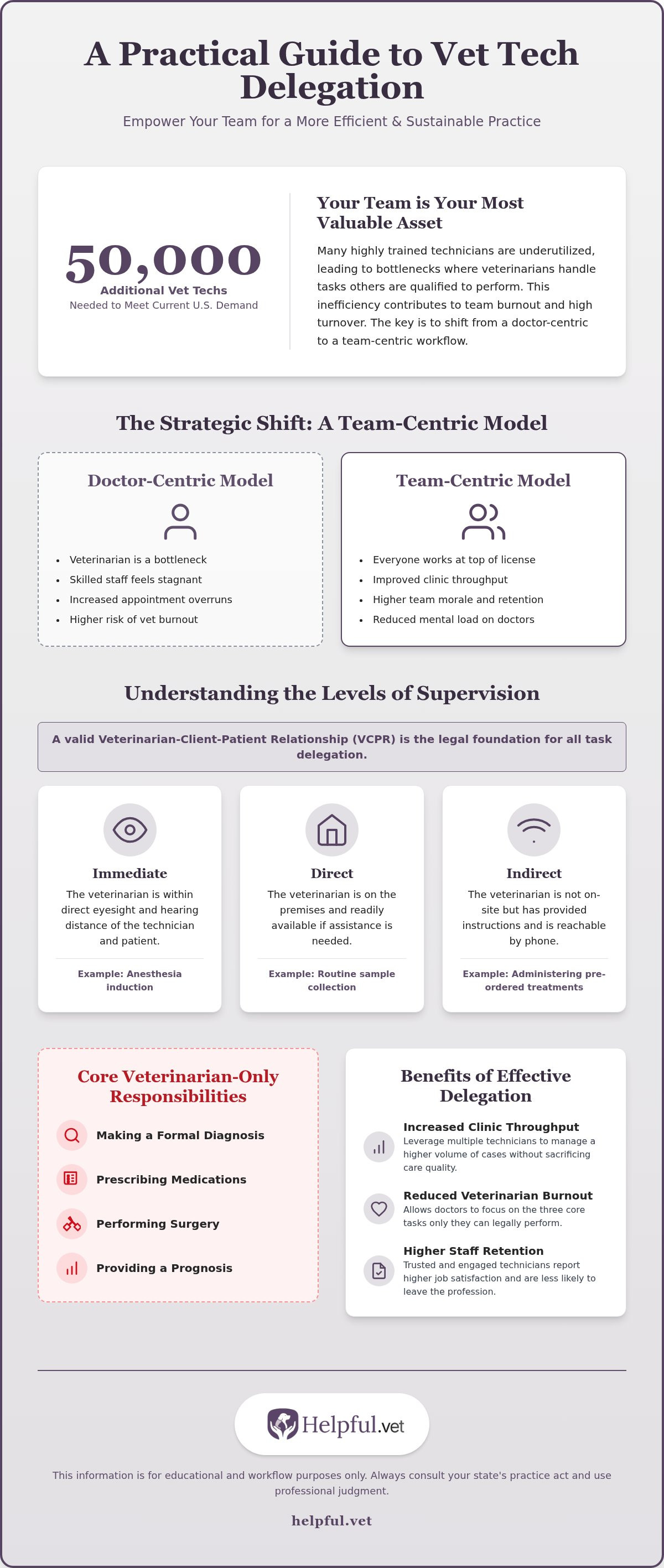
With an estimated 50,000 additional vet techs needed to meet current demand in the United States, your existing team is your clinic’s most valuable asset. You likely already know that your workflow could move faster if you weren't personally handling every blood draw or routine client update. It's a common struggle in general practice; veterinarians often find themselves tethered to technical tasks while their skilled staff feels underutilized and stagnant.
Mastering vet technician task delegation is about more than just clearing your plate; it's a strategic move to improve clinic throughput and reduce the burnout that leads to high turnover. This guide explains how to safely and effectively delegate tasks according to the latest professional standards and regional regulations. We will preview the different levels of supervision, review recent legislative updates from 2026, and provide a practical framework to help your team operate at the top of their license.
Key Takeaways
- Shift from a doctor-centric to a team-centric model to significantly increase clinic throughput and team morale.
- Master the legal nuances of direct versus indirect supervision to ensure safe and compliant vet technician task delegation.
- Identify untapped staff potential by conducting a systematic clinic-wide skill audit tailored to your practice.
- Build a sustainable delegation workflow using a step-by-step framework for creating clear Standard Operating Procedures.
- Learn which key performance indicators to track to justify the hiring of additional credentialed technicians for your GP team.
The Strategic Value of Maximizing Veterinary Technician Utilization
Technician utilization is defined as the percentage of a staff member's total skill set used during a typical shift. In many general practices, highly trained technicians spend significant portions of their day on kennel duties or basic cleaning. While these tasks are necessary, they don't require a credentialed professional. Shifting from a doctor-centric model to a team-centric model ensures that every person in the building is working at the top of their license or training level.
Strategic vet technician task delegation is the primary tool for reducing appointment overrun. When a technician is empowered to lead the intake process, collect samples, and prepare the room, the veterinarian can focus on high-level clinical decisions. This workflow doesn't just save time; it changes the energy of the exam room from frantic to methodical. While the specific titles for a Paraveterinary worker vary by region, their core purpose remains the same: providing expert medical support to ensure patient safety and clinic efficiency.
Impact on Clinic Throughput and Revenue
High utilization levels correlate directly with increased revenue per appointment. This is achieved through "leveraging," where one veterinarian works alongside multiple technicians to manage a higher volume of cases without sacrificing care quality. Instead of the doctor performing every blood draw, the technician handles the technical execution while the doctor moves to the next consultation. To see how these changes influence your specific practice metrics, you can use the GP Practice Benchmark Tool to track productivity gains.
Reducing Burnout through Professional Support
Delegation allows veterinarians to focus on the three core tasks only they can legally perform: diagnosing, prescribing, and performing surgery. This clarity reduces the mental load on the doctor and prevents the exhaustion that comes from trying to do everything at once. For the rest of the team, role alignment improves retention and professional satisfaction. Technicians who feel trusted to perform advanced tasks are more engaged and less likely to leave the profession, creating a more stable and reliable workplace for everyone.
Understanding the Regulatory Framework: Levels of Supervision
Successful vet technician task delegation depends on a clear understanding of legal boundaries. Before any task is assigned, a valid Veterinarian-Client-Patient Relationship (VCPR) must exist. This relationship is the legal foundation that allows a veterinarian to take responsibility for clinical judgments and ensures the client has agreed to follow the vet's instructions. Without a current VCPR, delegation isn't just inefficient; it's a regulatory risk.
Regulatory bodies generally define three levels of supervision to guide daily workflows:
- Immediate Supervision: The veterinarian is within direct eyesight and hearing distance of the technician and the patient. This is often required for high-risk procedures like anesthesia induction.
- Direct Supervision: The veterinarian is on the premises and is readily available for assistance if needed. The doctor doesn't have to be in the room but must be in the building.
- Indirect Supervision: The veterinarian is not required to be on the premises. They have provided written or oral instructions and remain reachable by phone or digital communication.
Navigating Your State Practice Act
Every state has its own specific task list and definitions. For example, the California vet tech regulations provide a granular breakdown of what Registered Veterinary Technicians (RVTs) can perform compared to unregistered assistants. As of 2026, several states have significantly updated these rules. Colorado now requires veterinarians to complete specific continuing education on delegation, while Minnesota has shifted to mandatory licensure to allow for broader remote supervision. Understanding these distinctions is vital for GP teams. Credentialed technicians typically have a broader legal scope than assistants, allowing for more advanced clinical support. You can use our Standard of Care Self-Check to ensure your current habits align with professional safety standards.
Safe Harbor: Tasks Generally Reserved for Veterinarians
Why this matters for GP teams: Knowing the "hard lines" of the law prevents accidental malpractice while maximizing team efficiency. While laws vary, certain tasks are almost universally reserved for licensed veterinarians. These include performing surgery, making a formal diagnosis, providing a prognosis, and prescribing medications. When legal language feels ambiguous, practitioners must use professional judgment to decide if a technician has the training to perform a task safely. If you want to stay updated on how these regulations are shifting across the country, consider signing up for our weekly clinical update.
How to Implement a Safe and Effective Delegation Workflow
Moving from a legal understanding of supervision to a functional daily routine requires a structured implementation plan. Effective vet technician task delegation isn't about offloading work randomly; it's about building a system where the right person handles the right task every time. This approach ensures patient safety while maximizing the doctor's time for complex clinical decisions.
Follow these four steps to integrate delegation into your clinic's DNA:
- Step 1: Conduct a skill audit. Inventory the specific technical abilities of your entire team. You might find a technician with advanced dental radiography skills or an assistant who excels at client education.
- Step 2: Establish clear SOPs. Create written Standard Operating Procedures for every delegated task. This ensures consistency and quality regardless of who is performing the procedure.
- Step 3: Use a competency sign-off. Implement a "teach, observe, trust" model. A technician shouldn't perform a task independently until a veterinarian has observed them completing it successfully multiple times.
- Step 4: Maintain communication protocols. Ensure there is a feedback loop where the technician reports findings back to the veterinarian immediately, maintaining the integrity of the VCPR.
Creating a Clinic-Wide Delegation Matrix
A delegation matrix is a visual chart that lists common clinic tasks alongside the staff members authorized to perform them. This tool serves as a quick reference for the entire team, reducing confusion during busy shifts. Beyond the logistics, a matrix fosters a culture of professional growth. When technicians see a clear path for expanding their responsibilities, they feel more empowered and invested in the clinic's success. This transparency helps eliminate bottlenecks by making it obvious who is available to help at any given moment.
Assessing Individual Competency Safely
Why this matters for GP teams: There is a significant difference between being "certified" to do a task and being "competent" in your specific clinic's environment. Competency involves understanding the nuances of your equipment, your specific patient population, and your preferred medical protocols. To keep quality high, use the Standard of Care Self-Check to regularly audit delegated workflows. This tool helps ensure that delegation never comes at the cost of clinical excellence. If you're looking for more practical tips on team optimization, sign up for our newsletter to get workflow guides delivered to your inbox.
Benchmarking Delegation Success for Long-Term Growth
Implementing a new workflow is only half the battle. To ensure your efforts stick, you must track how vet technician task delegation impacts your clinic's bottom line and team morale. Data provides the objective proof needed to move away from "the way we've always done it" toward a more sustainable, team-centric model. By monitoring specific key performance indicators (KPIs), you can identify exactly where your delegation strategy is succeeding and where bottlenecks still exist.
One of the most effective ways to use this data is to justify hiring additional credentialed technicians. When your current staff is fully utilized and the veterinarian is still performing technical tasks, the data will clearly show a plateau in patient volume. Using real-world numbers allows you to view your team as a "smart clinical sidekick," where you adjust your staffing and delegation levels based on actual clinic throughput rather than guesswork.
Using Data to Refine Your Workflow
A vital metric for measuring delegation efficiency is "revenue per labor hour." When a veterinarian delegates technical tasks effectively, they're free to focus on high-value clinical work, which naturally increases the revenue generated for every hour the team is on the clock. If this number is stagnant despite a high patient load, it's a signal that your delegation levels might be too low. You can find more strategies for measuring these shifts in our guide on Veterinary Team Productivity Tools, which helps GP teams optimize their daily operations.
Next Steps for Your GP Team
To start seeing these benefits, schedule a 30-minute team meeting this week specifically to discuss delegation barriers. Ask your technicians which tasks they feel ready to take on and identify which SOPs need to be written first. Open communication is the fastest way to turn a doctor-centric practice into a high-efficiency team.
Educational Disclaimer: This guide is for educational and workflow purposes only. All clinical content should be framed as educational, deferring to the licensed veterinarian’s professional judgment, patient history, and diagnostic findings. Always check your specific state practice act for the most current legal requirements regarding task delegation.
Optimizing Your Team for Long-Term Success
Transitioning to a team-centric model is a deliberate process that pays dividends in both clinic efficiency and staff professional satisfaction. By aligning roles with the latest 2026 legislative updates and established clinical standards, you protect your practice from regulatory risk while freeing veterinarians to focus on high-level medicine. Strategic vet technician task delegation acts as the catalyst for this change, turning untapped staff potential into measurable gains in patient throughput.
Data-driven insights from authoritative veterinary sources show that clinics with high technician utilization experience lower burnout and higher revenue per labor hour. Helpful.vet benchmarks are designed specifically for GP clinic workflows to help you identify these opportunities in your own practice. Explore our GP Practice Benchmark Tool and sign up for our weekly updates to see how your team utilization compares to industry standards. Your clinic's growth depends on the strength of your team. With the right delegation framework in place, you're well-positioned to build a more resilient and productive practice.
Frequently Asked Questions
What is the difference between a veterinary technician and a veterinary assistant in terms of delegation?
The primary difference lies in formal education and legal licensure status. Credentialed technicians, such as those with LVT, RVT, or CVT titles, have a broader legal scope than assistants. For example, recent 2026 updates in states like Minnesota now require mandatory licensure for technicians to perform advanced clinical duties. Assistants generally require more restrictive levels of supervision, often requiring a veterinarian to be on the premises for tasks a technician might perform remotely.
Can I legally delegate the induction of anesthesia to a licensed veterinary technician?
Legality depends on your specific State Practice Act, but many regions allow credentialed technicians to induce anesthesia under direct or immediate supervision. Several states updated their rules in 2026 to clarify these technical roles more specifically. It's critical to verify your local regulations, as some jurisdictions require a veterinarian to be physically present in the room while others only require them to be on the clinic premises.
How do I handle a client who insists that only the veterinarian perform technical tasks like drawing blood?
Address this by framing your technicians as highly trained medical professionals similar to human nurses. Explain to the client that vet technician task delegation allows the doctor to focus on the complex diagnosis while the technical expert handles the procedure. When the veterinarian introduces the technician as a skilled colleague, clients usually feel more comfortable. This consistent messaging across the entire GP team helps set professional standards and improves the overall workflow.
What happens if a delegated task results in a medical error or patient injury?
The licensed veterinarian is ultimately responsible for the outcome of any delegated task. This legal reality is why structured vet technician task delegation requires clear Standard Operating Procedures and documented competency sign-offs. If an error occurs, regulatory boards will evaluate whether the veterinarian provided the appropriate level of supervision and whether the staff member was qualified to perform the specific task. This information is for educational purposes only and you should always defer to your professional judgment.
How can I track if our delegation efforts are actually improving clinic efficiency?
Tracking efficiency is best done through specific metrics like revenue per labor hour and technician-to-doctor ratios. If your delegation is working, you should see a decrease in appointment overruns and an increase in the number of patients seen per shift. Using data-driven benchmark tools allows you to compare your clinic's performance against industry standards. This helps you see if your workflow changes are producing a measurable return on investment for the practice.

Article by
The Helpful.vet Team
The Helpful.vet Team creates practical resources, tools, and checklists for busy general practice veterinary teams. Our content focuses on clinic workflow, client communication, benchmarks, practice efficiency, and everyday tools that help veterinary professionals work with more clarity.
Disclaimer
Helpful.vet provides educational and workflow-related information for veterinary professionals. Content on this site does not provide medical advice, diagnosis, or treatment recommendations and should not replace the judgment of a licensed veterinarian. Clinical decisions should always be made using patient-specific history, examination findings, diagnostics, applicable guidelines, and professional judgment.