.png?width=3799&height=728&name=Dark_Logo_R-01%20(1).png "SignalPET")
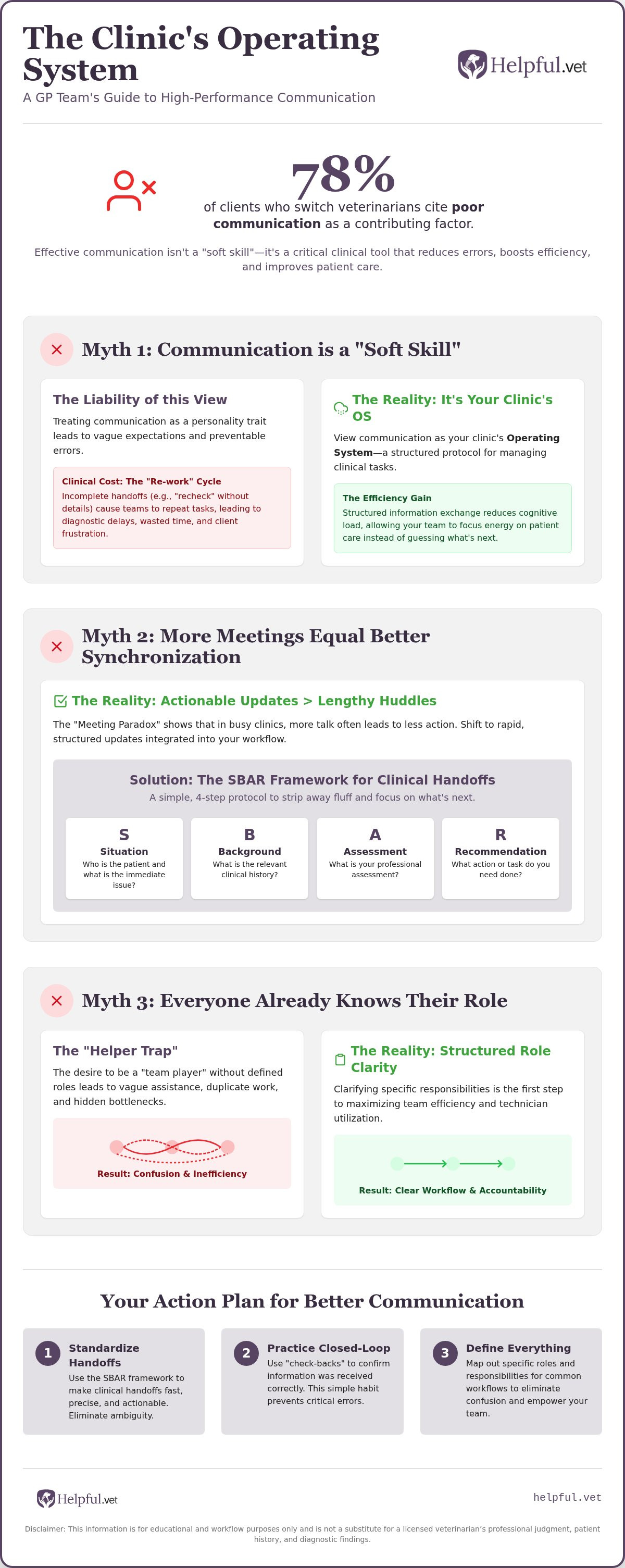
Did you know that 78% of clients who switch veterinarians cite poor communication as a contributing factor? When you're managing a packed surgical schedule and an overflowing lobby, the process of improving veterinary team communication often feels like a luxury you don't have time for. You've likely felt the frustration of an appointment overrunning because a clinical handoff was unclear, or the drain of duplicate work because roles weren't defined. These aren't just minor annoyances; they are symptoms of a workflow that is working against your team's efficiency.
We believe that communication should be treated as a clinical tool, much like a diagnostic protocol, rather than a vague personality trait. Our goal is to help you transform your internal dialogue into a high-performance system that reduces burnout and improves patient safety. This article examines five common myths that hinder clinic efficiency and provides actionable steps to help your team function like a synchronized, well-oiled machine.
Key Takeaways
- Learn why treating communication as a clinical operating system rather than a soft skill is essential for reducing medical errors.
- Discover how to solve the "Meeting Paradox" by shifting from general broadcast information to actionable workflow updates.
- Understand how clarifying specific roles and responsibilities is the first step toward improving veterinary team communication and maximizing technician utilization.
- Identify how the "Helper Trap" creates hidden bottlenecks and learn to replace vague assistance with structured role clarity.
- See how using data-driven tools can help you identify communication gaps and benchmark your practice against industry standards.
Myth 1: Communication is a Soft Skill, Not a Clinical Tool
Communication is often categorized as a soft skill, something that depends on individual personalities or "people skills." In a high volume general practice, this view is a liability. It's more accurate to view communication as the clinic's operating system. Just as your practice management software manages patient data, your team’s communication manages the flow of clinical tasks. When this system fails, the result isn't just a "bad vibe" in the breakroom; it's a direct cause of medical errors and diagnostic delays.
By reframing communication as a clinical tool, you can move away from vague expectations and toward measurable protocols. Improving veterinary team communication is about reducing the cognitive load on your staff. When every team member knows exactly what information they need to provide and receive, they spend less energy "guessing" and more energy on patient care. This shift preserves your most valuable clinic resource: time.
The Clinical Cost of Poor Communication
Consider a common workflow scenario with a patient like Florence the Great Dane. If the front desk notes a "recheck" but doesn't specify it's for a persistent cough, the technician might start a routine history while the veterinarian prepares for a surgical follow-up. This misalignment creates "re-work," where tasks must be repeated or corrected because the initial information was incomplete. These friction points are often cited when discussing effective teamwork characteristics that are missing in high stress environments. In a GP setting, these gaps lead to diagnostic delays and client dissatisfaction, ultimately impacting the standard of care.
Reframing Communication for Efficiency
To improve clinic throughput, we must transition from "talking" to "structured information exchange." This means creating standardized handoff protocols that are as rigorous as your anesthesia monitoring charts. Why this matters for GP teams is that it removes the ambiguity that leads to burnout. You can use the GP Practice Benchmark Tool to identify exactly where workflow friction is occurring in your specific practice. This data-driven approach allows you to treat communication gaps as operational bugs that can be fixed with better protocols rather than personality changes.
Myth 2: More Meetings Equal Better Team Synchronization
Many practice managers believe that frequent meetings lead to better alignment. However, the "Meeting Paradox" suggests that in a busy general practice, more talk often leads to less action. When the goal is improving veterinary team communication, the focus should be on workflow integration rather than sitting in a breakroom. Why this matters for GP teams is clear. Every minute a technician spends in a staff meeting is a minute they aren't performing revenue-generating tasks or assisting patients. Modern clinics are shifting away from lengthy huddles in favor of asynchronous tools for broadcast information. This allows the team to focus on improving veterinary team communication through rapid, actionable updates that happen in real-time.
Implementing SBAR for Rapid Clinical Handoffs
One way to eliminate the need for long huddles is the SBAR framework. This system stands for Situation, Background, Assessment, and Recommendation. It strips away fluff and focuses on what the next person in the workflow needs to do. For example, a veterinarian might tell a technician: "This is Max, a 4-year-old Lab (Situation) here for a hot spot (Background). I suspect a flea allergy (Assessment). Please clip, clean, and prep 5mg of Apoquel (Recommendation)." This framework often saves 5 to 10 minutes per patient by removing the need for clarifying questions and reducing the mental energy required to process a handoff.
Closed-Loop Communication in the Exam Room
In a fast-paced exam room, hearing an order isn't the same as confirming it. Closed-loop communication uses "check-backs" to verify that information was received correctly. When a technician repeats back, "I have the 10mg of Apoquel," they provide an immediate safety check that prevents dosing errors. You can adopt these habits without feeling robotic by keeping the confirmations brief and integrated into your natural movement. If you want more practical tips like these delivered to your inbox, you can subscribe to our workflow updates. These small shifts in daily habits do more for synchronization than a dozen monthly meetings.
Myth 3: Everyone Already Knows Their Role and Responsibilities
In a busy general practice, the desire to be a "team player" can ironically lead to bottlenecks. This is often called the "Helper Trap." It occurs when team members jump into tasks outside their primary responsibility to fill a perceived gap. While well-intentioned, "helping out" without a defined workflow often backfires. Consider these common friction points:
- A technician stops an ear swab to help a client at the front desk.
- A veterinarian cleans a kennel while a surgery patient waits for an exam.
- A receptionist tries to explain a medication side effect instead of paging a nurse.
Improving veterinary team communication requires moving past the idea that everyone should do everything. Real efficiency comes from staying in your assigned lane. When everyone is "helping," nobody is leading the workflow.
Maximizing Technician Utilization Through Clarity
Role clarity is the foundation of high technician utilization. When roles are ambiguous, your most skilled staff often end up performing tasks below their license level. You can use the Vet Tech Task Delegation Guide to audit how your team currently spends their time. By implementing strategies for effective team communication, you ensure that every staff member knows their specific "lane" for the day. This prevents the overlapping work that leads to frustration and burnout. Improving veterinary team communication isn't just about being polite; it's about maximizing the clinical output of every team member.
The Workflow Checklist as a Communication Device
A physical or digital Veterinary Clinic Workflow Checklist acts as a silent communicator. It tells the rest of the team exactly where a patient is in the process without anyone needing to ask. This reduces the constant "status check" interruptions that break a veterinarian's concentration or distract a technician during a blood draw. Why this matters for GP teams is that it empowers staff to "own" their station through visual cues. When the checklist is visible, the communication is automated. This creates a more predictable environment where tasks don't fall through the cracks. If you want to refine your clinic's daily routines, subscribe to our newsletter for actionable templates and guides.
Measuring Success: Data-Driven Communication Strategies
Improving veterinary team communication is often viewed through a subjective lens, making it difficult to address during performance reviews. However, you cannot improve what you do not measure. By shifting to a data-driven approach, you remove the emotion from management and focus on objective workflow results. Why this matters for GP teams is that it provides a clear roadmap for professional development without the friction of personal criticism. When communication is quantified, it becomes a goal the entire team can work toward together.
A 30-minute "Communication Audit" can reveal immediate bottlenecks. Start by reviewing your Client Communication Score to identify where external gaps might be reflecting internal confusion. If clients are frequently calling back with questions about discharge instructions, it's likely that the handoff between the veterinarian and the technician lacks the necessary clarity. This audit allows you to pinpoint exactly where the "operating system" is glitching.
Key Performance Indicators for Team Communication
To track progress, use specific Key Performance Indicators (KPIs) that reflect daily operations. Track appointment overrun times as a direct proxy for communication efficiency. If a 20-minute appointment consistently takes 35 minutes, a handoff or role clarity issue is likely present. Additionally, monitor your "call-back" volume. A high number of calls for clarification indicates that exam room communication didn't meet the client's needs. Utilizing Veterinary Team Productivity Tools can help your practice gather this objective data automatically, allowing you to focus on clinical care rather than manual tracking.
Next Steps for Your Clinic
Transformation doesn't happen overnight. Choose one framework, such as the SBAR pilot discussed earlier, and commit to it for one week. Set a baseline for your current technician utilization rate to see how much more your team can accomplish with better clarity. Finally, invite your team to identify the "noisiest" part of their daily workflow. By focusing on the area with the most friction, you make improving veterinary team communication a collaborative and rewarding process for everyone in the clinic. These small, data-backed adjustments lead to a more synchronized environment and better patient outcomes.
Building a More Synchronized Clinic Workflow
Transforming your practice starts with the realization that communication is a clinical protocol, not an optional soft skill. By moving away from the "Helper Trap" and implementing structured frameworks like SBAR, you reclaim the time lost to confusion and rework. Improving veterinary team communication is a measurable process that directly impacts your clinic's bottom line and technician utilization rates. It's essential to treat your internal dialogue as a workflow tool to reduce the cognitive load on your staff and create a safer environment for your patients.
The transition to a data-driven culture allows your team to focus on clinical excellence rather than daily friction. Utilizing interactive workflow tools designed for GP teams and leveraging data-driven insights from Helpful.vet benchmarks provides the objective clarity needed to address bottlenecks without the stress of personal performance reviews. Small, methodical changes in how you hand off cases or verify orders can turn a chaotic shift into a predictable, high-performance day.
Ready to optimize your daily operations? Benchmark your clinic performance today with our free GP Practice Tool and receive actionable insights delivered to your inbox. You have the skills to provide exceptional care; now, give your team the communication system they deserve to succeed.
Disclaimer: This information is for educational and workflow purposes only. It is not intended as medical advice, a diagnosis, or treatment instructions. All clinical decisions must be deferred to the licensed veterinarian's professional judgment, patient history, and diagnostic findings.
Frequently Asked Questions
What is the most common cause of communication breakdown in vet clinics?
The primary cause of breakdown is often role ambiguity coupled with a lack of standardized handoff protocols. When teams rely on "helping out" rather than following defined clinical workflows, information gets lost in the transition between front-of-house and clinical staff. This breakdown typically happens during peak hours when the cognitive load is highest and the team reverts to informal, unstructured habits that lead to errors.
How does better team communication reduce veterinary staff burnout?
Improving veterinary team communication reduces burnout by lowering the daily cognitive load on each staff member. Clear communication ensures that tasks are done correctly the first time, preventing the frustrating "re-work" that drains mental energy. When a team operates with high role clarity, individuals spend less time guessing and more time performing the clinical tasks they were trained for, which significantly lowers workplace stress.
What is the SBAR method and how do I use it in a veterinary setting?
The SBAR method is a structured framework used to provide rapid clinical updates by focusing on Situation, Background, Assessment, and Recommendation. In a clinic, you use it by stating the patient's current status, relevant medical history, your clinical assessment, and the specific next step required. This protocol removes irrelevant details, allowing for significant time savings during patient handoffs compared to unstructured, conversational updates.
Can improving communication actually increase clinic revenue?
Yes, better communication increases revenue by maximizing technician utilization and reducing appointment overruns. When the team is synchronized, technicians work at the top of their license, which frees veterinarians to see more patients. Efficient communication also prevents missed charges and reduces the volume of unpaid "call-backs" that take staff away from revenue-generating tasks. Why this matters for GP teams is that it turns communication into a measurable financial asset.
How do I introduce new communication protocols to a resistant team?
Start by using objective data to explain how the change benefits the team's daily workflow rather than just the clinic's bottom line. Introduce a small, one-week pilot for a single protocol, like a new surgical handoff checklist, to prove its effectiveness without overwhelming staff. Inviting the team to identify the "noisiest" part of their own day ensures they feel like partners in the solution rather than subjects of a new management rule.
Article by
The Helpful.vet Team
The Helpful.vet Team creates practical resources, tools, and checklists for busy general practice veterinary teams. Our content focuses on clinic workflow, client communication, benchmarks, practice efficiency, and everyday tools that help veterinary professionals work with more clarity.
Disclaimer
Helpful.vet provides educational and workflow-related information for veterinary professionals. Content on this site does not provide medical advice, diagnosis, or treatment recommendations and should not replace the judgment of a licensed veterinarian. Clinical decisions should always be made using patient-specific history, examination findings, diagnostics, applicable guidelines, and professional judgment.