.png?width=3799&height=728&name=Dark_Logo_R-01%20(1).png "SignalPET")
Most veterinary teams view a conference as a necessary expense for CE credits, but the most successful clinics treat these events as high-yield operational investments. It's often difficult to justify registration fees and travel costs for veterinary conferences 2026 when your clinic is already facing staffing shortages and tight margins. You likely feel the pressure of choosing the right event while ensuring the schedule doesn't collapse while you are away from the practice.
We understand that your time is your most valuable resource. This guide provides a comprehensive roadmap to the most impactful 2026 veterinary conferences, including essential dates for VMX in Orlando and the AVMA Convention in Anaheim. Beyond a simple calendar, we offer a strategic framework for selecting events that align with your clinic’s specific growth benchmarks. You will learn how to justify these costs through improved operations and create a professional development plan that empowers your entire team. We will walk through the top national and regional shows, compare virtual options, and show you how to turn conference takeaways into actionable clinic protocols.
Key Takeaways
- Use clinic benchmarks to identify specific knowledge gaps before booking travel. This ensures your CE budget targets your practice's actual needs.
- Evaluate the landscape of veterinary conferences 2026 by distinguishing between large national expos for new technology and regional events for focused clinical skills.
- Plan your year using a quarterly roadmap of confirmed dates to manage staffing schedules and budget constraints effectively.
- Implement a structured post-conference download with the whole team to translate new insights into concrete workflow changes.
The 2026 Veterinary Conference Landscape: National vs. Regional Events
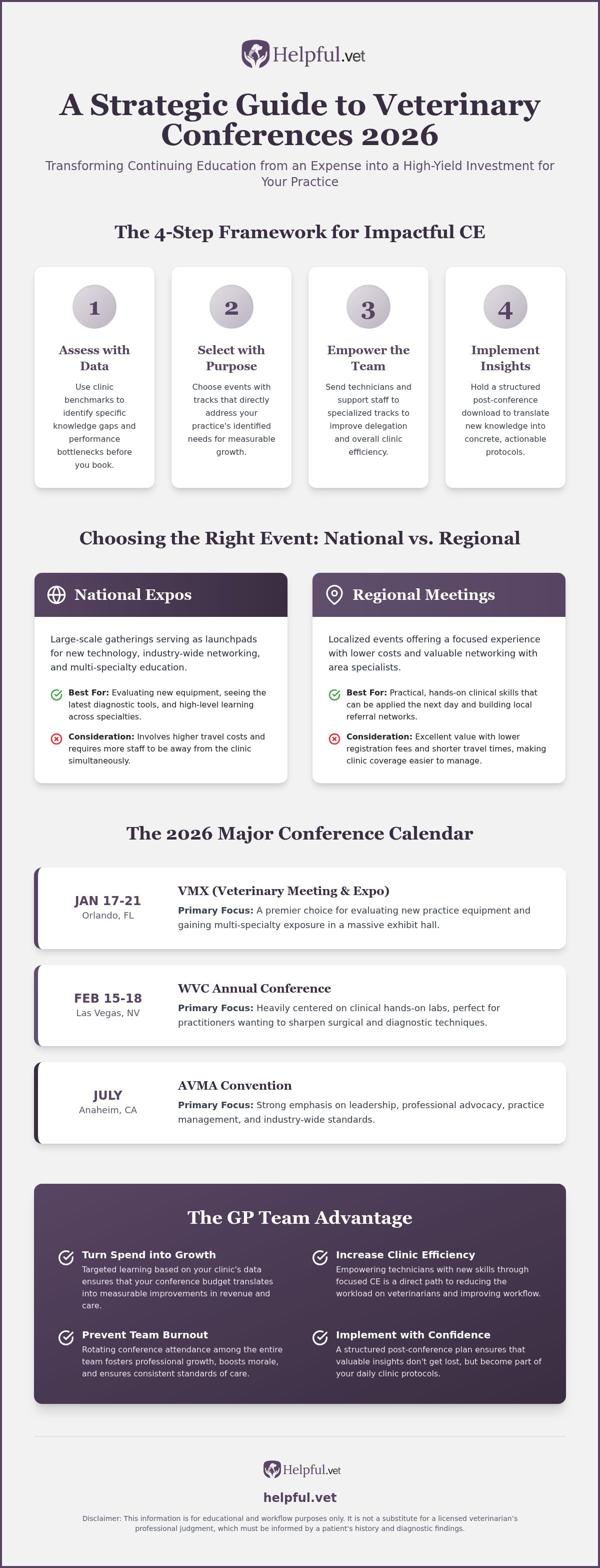
Choosing between the various veterinary conferences 2026 requires a clear understanding of what each tier offers your team. National events are typically massive gatherings that serve as a launchpad for new technology and industry-wide networking. These are the best places to see the latest diagnostic tools in action across the entire field of Veterinary medicine. However, they often involve higher travel costs and require more staff to be away from the clinic at once.
Regional meetings offer a more localized experience with lower registration fees and shorter travel times. These events are excellent for networking with local specialists and focusing on practical skills that can be applied the next day. For many general practices, the best strategy involves a mix. You might send one doctor to a national expo while technicians attend regional meetings to ensure the clinic stays fully staffed and operational. It's about finding the right balance between high-level exposure and clinic coverage requirements.
Major National Expos: VMX, WVC, and Summer Conventions
VMX in Orlando, scheduled for January 17 to 21, is known for its multi-specialty exposure and massive exhibit hall. It is a prime choice for teams looking to evaluate new practice equipment. The WVC Annual Conference in Las Vegas, running from February 15 to 18, focuses heavily on clinical hands-on labs. These sessions are perfect for practitioners wanting to sharpen surgical or diagnostic techniques in a focused environment. Additionally, the major national convention held in Anaheim during July provides a strong focus on leadership, advocacy, and professional standards.
Specialty and Leadership Meetings for 2026
Focused events like the Veterinary Leadership Conference (VLC) provide targeted tracks for practice managers and owners looking to optimize clinic operations. If your team wants to expand specific services, such as emergency care, meetings like IVECCS offer specialized tracks that general conferences might not cover in depth. Before committing to a specific event among the veterinary conferences 2026, use the GP Practice Benchmark Tool to see which clinical areas in your practice would benefit most from targeted education.
Strategic Planning: Selecting Conferences Based on Clinic Benchmarks
Attending veterinary conferences 2026 shouldn't be a random choice based on location or social perks. It's a strategic decision that starts with your practice's data. If you don't know where your clinic is underperforming, you can't choose the sessions that will fix those bottlenecks. We take a colleague-to-colleague approach to this planning. It isn't about prestige; it's about advancing academic veterinary medicine in a way that directly impacts your daily schedule. This ensures every hour spent away from the exam room contributes to the long-term health of the practice. Without a clear plan, you risk spending thousands of dollars on education that never actually reaches the treatment floor.
Aligning CE with Practice Performance Metrics
Before you book your flights, take a look at your current numbers. Using the GP Practice Benchmark Tool helps you pinpoint exactly where your team might be struggling. If your dental revenue is lower than industry standards, prioritize conferences with heavy dentistry tracks. You can find more context on these targets in our 2026 Veterinary Clinic Benchmarks: GP Operational Guide. Why this matters for GP teams: Targeted learning ensures that conference spend translates into measurable clinic growth rather than just generic credits.
Planning for Staff Utilization and Team Growth
Consider sending more than just the doctors. High-performing clinics send technicians to specialized tracks to improve delegation. If a tech learns advanced imaging or anesthesia monitoring at veterinary conferences 2026, they return as a more valuable asset who can free up the veterinarian's time. Rotating attendance among the team prevents burnout and ensures that standard of care remains high across all shifts. Why this matters for GP teams: Empowering technicians through targeted CE is one of the fastest ways to increase clinic efficiency and reduce the workload on veterinarians. To stay updated on more workflow strategies, consider joining our community of practice leaders.
The 2026 Veterinary Conference Calendar: Key Dates and Locations
Planning your year around veterinary conferences 2026 is the only way to protect your clinic's workflow. If you wait until the last minute to book, you'll likely face staffing shortages that make it impossible for the team to attend without disrupting patient care. Advanced scheduling allows you to rotate staff and take advantage of early bird pricing, which often expires months before the doors open. Proper coordination ensures that the clinic remains fully operational while key team members gain the skills needed to improve the practice benchmarks discussed earlier.
Q1 and Q2: The High-Impact Spring Season
The first half of the year is traditionally the busiest for major national events. These dates are essential for teams looking to jumpstart their professional development goals early in the year.
- VMX (Orlando, FL): January 17 to 21. Focus: Multi-specialty exposure and new technology.
- WVC Annual Conference (Las Vegas, NV): February 15 to 18. Focus: Clinical hands-on labs and technician tracks.
- Midwest Veterinary Conference (Columbus, OH): Typically late February. Focus: Regional networking and practical GP clinical tracks.
- Fetch Charlotte (Charlotte, NC): Typically March. Focus: Interactive clinical and management sessions.
Early registration is vital for budgeting. For VMX 2026, early bird deadlines often end nearly a year in advance, while WVC registration fees vary significantly based on the clinical labs you select. Missing these windows can easily double your registration costs.
Q3 and Q4: Summer Conventions and Fall Wrap-Ups
The summer and fall seasons offer a mix of large scale conventions and focused regional symposiums. The Anaheim Summer Convention, held from July 10 to 14, is a major highlight. It provides critical updates on the intersection of Veterinarians and public health, a topic that is becoming increasingly important for general practitioners managing zoonotic risks in their communities.
- PacVet (Sacramento, CA): June 18 to 21. Focus: Clinical and practice management.
- Fetch Kansas City (Kansas City, MO): August 28 to 30. Focus: Clinical and workflow optimization.
- Wild West Vet (Reno, NV): Typically October. Focus: Practical, small animal clinical tracks.
Advanced planning prevents the CE scramble that often happens in November. To stay ahead of these deadlines and receive practical planning tips for veterinary conferences 2026, join our community of practice leaders for monthly workflow updates.
From Learning to Leading: Implementing Conference Insights
The real work begins when the exhibit halls close and the team returns to the clinic. It's common to return from veterinary conferences 2026 with high energy and a long list of ideas, only to have them buried by the first emergency surgery on Monday morning. This post-conference slump is where most professional development investments fail. To avoid this, schedule a post-conference download within three days of your return. This isn't a time to share every detail; it's a focused session to select one specific workflow to optimize. Why this matters for GP teams: New knowledge only creates value if it becomes a standard protocol in your daily operations.
Building a Post-Conference Action Plan
Success requires moving from abstract ideas to concrete steps. Start by assigning a protocol champion for the chosen takeaway. If you learned a new dental technique at WVC, that champion should draft a step-by-step guide for the rest of the doctors. You can use our Helpful.vet tools to track how these changes impact your efficiency. For a deeper look at managing this transition, see our Veterinary Education: 2026 Operational Guide. Focus on incremental changes rather than trying to overhaul the entire clinic at once to prevent innovation fatigue.
Measuring the Impact on Clinic Efficiency
Set a 90-day goal for any new clinical or operational skill. If the goal was to improve technician utilization based on a track from veterinary conferences 2026, check your benchmarks at the three-month mark. Use data to prove the ROI to the practice owner. When you can show that a technician-led imaging protocol increased doctor availability by 15 percent, the cost of the conference is easily justified. This data-driven approach turns a trip into a measurable business win.
This information is for educational and workflow purposes only. All clinical decisions should be made by a licensed veterinarian based on patient history and diagnostic findings.
Turning 2026 Learning into Clinical Success
Strategic planning for veterinary conferences 2026 is more than just picking a destination on a map. It requires a clear understanding of your clinic's current performance and a commitment to bringing those new insights back to the exam room. By selecting events that target your specific knowledge gaps and organizing a structured post-conference download, you ensure that every registration fee generates a real return for the practice. Helpful.vet tools are designed for GP teams to streamline these real-world workflows, helping you move from the lecture hall to the treatment floor with confidence.
Success isn't measured by the number of CE credits you earn, but by the improvements your team implements. Please remember that clinical content provided here is for educational purposes only; you should always defer to the licensed veterinarian’s professional judgment, patient history, and diagnostic findings. Before you finalize your travel budget for the year, join our community for monthly workflow resources and planning tools that help you lead your practice with precision. We look forward to seeing your team grow and thrive throughout the coming year.
Frequently Asked Questions
How do I choose between a national expo and a regional conference?
Base your choice on your specific goals for the practice year. National expos are the best option if your team needs to evaluate new equipment or build a broad professional network across the industry. Regional meetings are often better for focused clinical skills and reducing travel stress for the whole team. Consider sending a lead doctor to a national event while technicians attend a regional one to balance the budget and clinic coverage.
What is the average cost of attending a veterinary conference in 2026?
Registration fees for veterinary conferences 2026 typically range from $125 for early bird national events to over $900 for late registration non members. Total costs often reach $2,000 to $3,000 per person once you include airfare, meals, and lodging. To manage these expenses, aim for early bird deadlines which often close several months before the event. Virtual registration remains a cost effective alternative with fees usually falling between $245 and $450.
Can I earn all my required CE credits at one conference?
You can often earn all your required annual CE credits at a single major event. Large national conferences provide hundreds of hours of content across multiple tracks, allowing you to fulfill most state requirements in just a few days. However, always verify that the specific sessions are RACE approved for your license type and state. Some practitioners prefer splitting credits between a large conference and smaller, specialized workshops to stay updated on diverse clinical topics throughout the year.
How should I plan clinic staffing when half the team wants to attend the same event?
Implement a rotation system where team members alternate attendance years to maintain clinic coverage. If multiple staff members want to attend the same veterinary conferences 2026, consider a hybrid approach where some attend in person while others use virtual passes. This allows the whole team to benefit from the education without leaving the clinic understaffed. You can also offer on site CE days where virtual attendees share their learnings with the team during lunch breaks.
Are there specific conferences for veterinary practice managers in 2026?
Several events focus exclusively on the operational side of the practice. The Veterinary Leadership Conference and the VHMA Annual Conference are top choices for practice managers looking to improve clinic benchmarks and team culture. Additionally, major national shows now offer dedicated management and Business of Medicine tracks. These sessions provide practical tools for workflow optimization and financial management that are essential for the GP leadership team.

Article by
The Helpful.vet Team
The Helpful.vet Team creates practical resources, tools, and checklists for busy general practice veterinary teams. Our content focuses on clinic workflow, client communication, benchmarks, practice efficiency, and everyday tools that help veterinary professionals work with more clarity.
Disclaimer
Helpful.vet provides educational and workflow-related information for veterinary professionals. Content on this site does not provide medical advice, diagnosis, or treatment recommendations and should not replace the judgment of a licensed veterinarian. Clinical decisions should always be made using patient-specific history, examination findings, diagnostics, applicable guidelines, and professional judgment.